How to Setup Xiaohongshu Business Account for Foreign Businesses Self-Check
Author: Qiang wang
Xiaohongshu business account for foreign companies is not a simple registration task. It is a compliance check, a documentation exercise, a naming decision, and a market-entry filter all at once.
At Twish, we have seen the same pattern again and again: overseas brands assume account opening is the easy part, then get stuck on industry fit, trademark logic, naming rules, missing qualifications, or entity-document inconsistencies. That is why I do not think the smartest first question is, “How do we open the account?” The better question is: should we apply at all, are we actually eligible, and what will get us rejected before we even start?
Twish point of view: the best account-opening article is not the one that attracts the most casual clicks. It is the one that helps the wrong-fit lead self-disqualify and helps the right-fit lead arrive better prepared.
Quick answer: can foreign companies open a Xiaohongshu business account?
Yes, some foreign companies can apply for a Xiaohongshu professional business account without first setting up a mainland China entity. But this is not a blanket yes.
Your outcome usually depends on five things:
- your registration jurisdiction
- your industry category
- your supporting licences or qualifications
- your trademark and naming logic
- whether your documents are complete, consistent, and translatable into a clean verification pack
That is why a Xiaohongshu business account for foreign companies should be treated as an eligibility question first, and a registration process second.
If your industry is highly regulated, your documents are inconsistent, or your naming relies on weak trademark logic, the issue is not speed. The issue is fit.

Why Xiaohongshu business account for foreign companies matters more than most brands think
On Western social platforms, you can often set up a business profile quickly and sort out the finer details later.
Xiaohongshu is different.
The platform sits at the intersection of search, discovery, reviews, social proof, and purchase intent. A user may see your note, search your brand name, compare you with creator content, look for proof, read comments, and then decide whether your account feels official enough to trust.
That means a Xiaohongshu business account for foreign companies is not simply about having an account badge. In practice, a Xiaohongshu business account for foreign companies becomes a visible trust signal only when the verification logic and operating logic both hold up.
From a brand perspective, the real risks are usually these:
- you choose the wrong category and trigger manual review problems
- you apply with an entity structure that looks unclear
- you use a brand name that your applicant entity cannot properly support
- you underestimate industry restrictions
- you get verified, but your China-facing content and lead-handling system are still not ready
I have seen brands treat account opening as a tiny admin step. In reality, it is a market-readiness checkpoint.
Why Twish approaches this differently
Most agencies answer this topic too softly because they still want the lead. We prefer to be clearer.
If a brand is in a poor-fit category, has weak commercial readiness, or does not have the right document logic, the most helpful answer is not a vague “maybe”. It is a sharper judgement on whether the brand should proceed, pause, or restructure the submission path first.
That is better for trust. It is better for timelines. And it usually saves the client money.
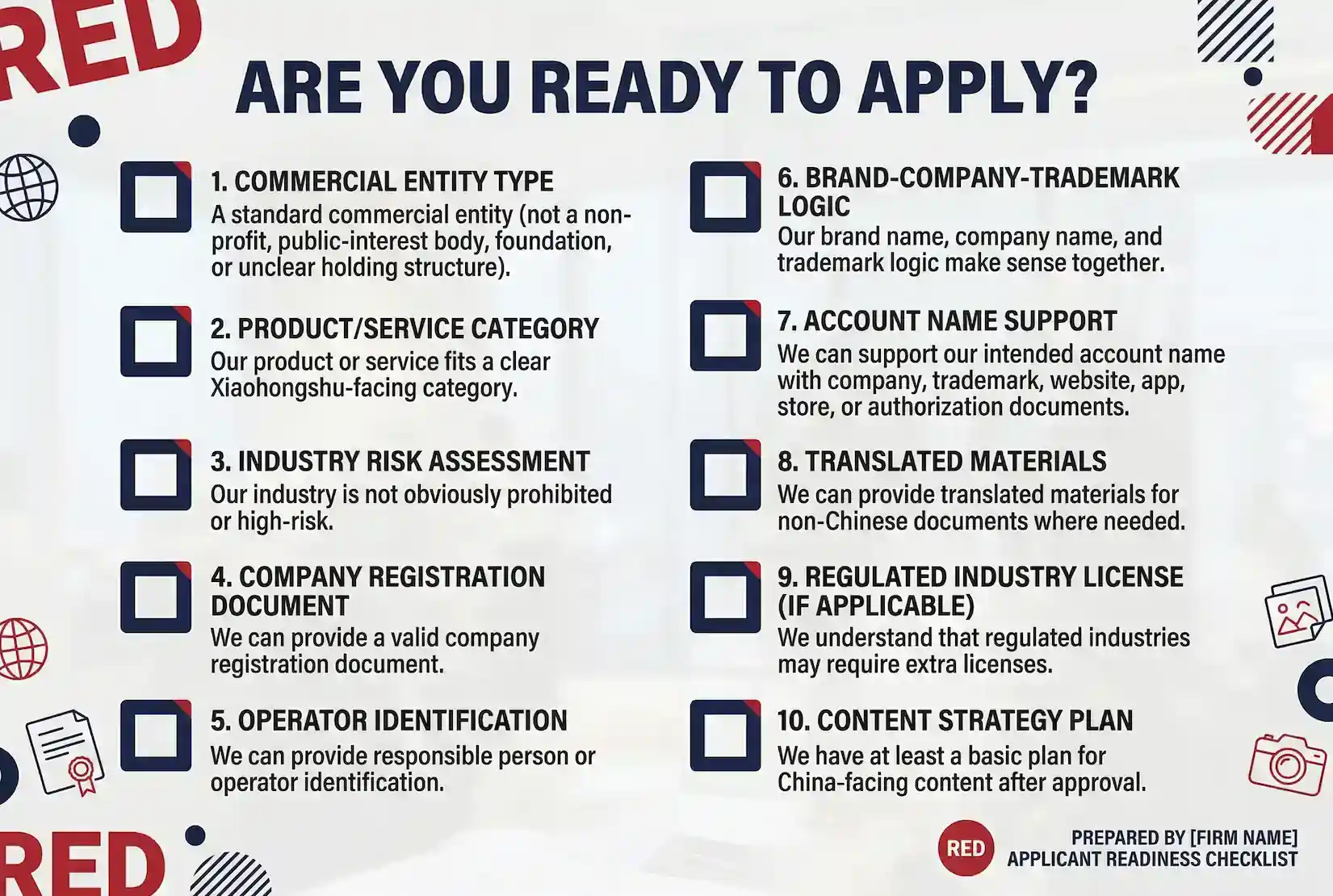
A 60-second self-check before you apply for a Xiaohongshu business account
Use this before you contact an agency, before you start collecting documents, and definitely before you promise an internal launch date. A rushed Xiaohongshu business account for foreign companies submission is one of the easiest ways to create avoidable delays.
Self-check checklist
- We are a standard commercial entity, not a non-profit, public-interest body, foundation, or unclear holding structure.
- Our product or service fits a clear Xiaohongshu-facing category.
- Our industry is not obviously prohibited or high-risk.
- We can provide a valid company registration document.
- We can provide responsible person or operator identification.
- Our brand name, company name, and trademark logic make sense together.
- We can support our intended account name with company, trademark, website, app, store, or authorisation documents.
- We can provide translated materials for non-Chinese documents where needed.
- We understand that regulated industries may require extra licences.
- We have at least a basic plan for China-facing content after approval.
If you cannot tick at least 8 out of 10, do not rush straight into submission. You probably need an eligibility review first.
Who is usually a fit for a Xiaohongshu business account for foreign companies?
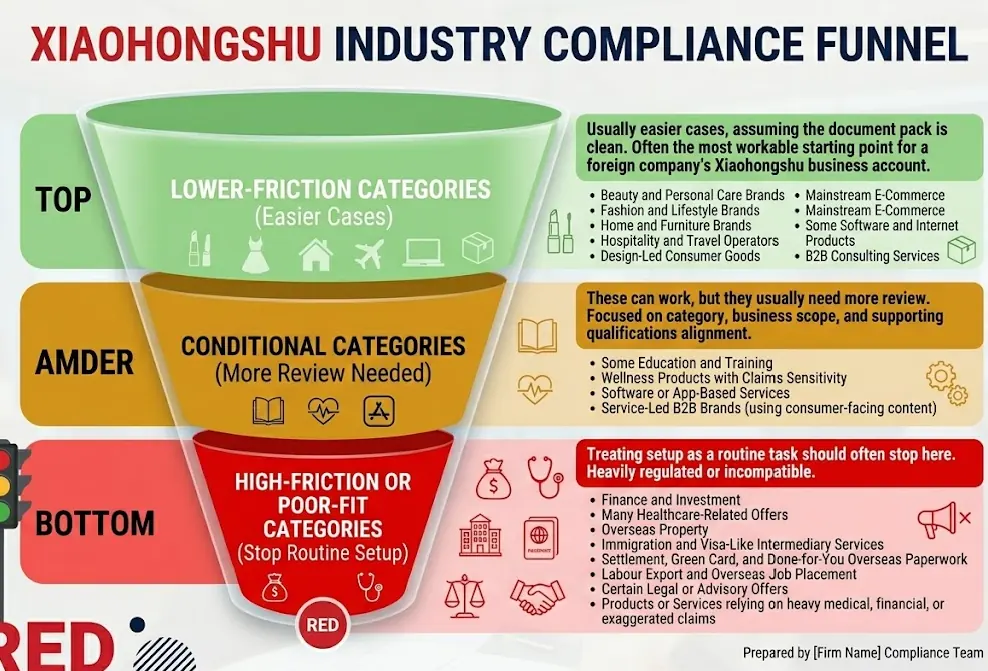
Not every overseas business is equally well suited to the platform. In broad terms, these groups are often more workable.
Lower-friction categories
These are usually the easier cases, assuming the document pack is clean:
- beauty and personal care brands
- fashion and lifestyle brands
- home and furniture brands
- hospitality and travel operators
- design-led consumer goods
- mainstream e-commerce businesses
- some software and internet products
- B2B consulting services
They are often easier to assess because the business model is relatively clear and consumer-facing. For that reason, they are often the most workable starting point for a Xiaohongshu business account for foreign companies.
Conditional categories
These can work, but they usually need more review:
- Some education and training
- wellness products with claims sensitivity
- software or app-based services
- service-led B2B brands trying to market through consumer-facing content
In these cases, a Xiaohongshu business account is less about whether the company exists, and more about whether the category, business scope, and supporting qualifications line up.
High-friction or poor-fit categories
This is where many teams should stop treating setup as a routine task.
Examples include:
- finance and investment
- many healthcare-related offers
- overseas property
- immigration and visa-like intermediary services
- settlement, green card, and done-for-you overseas paperwork
- labour export and overseas job placement
- certain legal or advisory offers
- products or services relying on heavy medical, financial, or exaggerated claims
If your business lives in a policy-sensitive category, do not start with registration. Start with feasibility.
The biggest mistake: assuming all foreign companies are treated the same
This is where most setup articles become too vague. In practice, admission requirements are tied to both jurisdiction and industry.
What that means in plain English
You should not just ask:
“Can a foreign company open an account?”
You should ask:
“Can our specific overseas entity, in our specific category, with our specific supporting documents, apply under the current rules?”
That is a much stronger question.
For example, overseas applicants from different jurisdictions may face different supporting qualification requirements across categories like ecommerce, software, travel, education, and beauty. So a Singapore travel company, a Hong Kong ecommerce business, and a Malaysian software firm do not necessarily follow the same supporting logic.
What you should map before submitting
Use this mini framework:
| What to map | What to ask |
|---|---|
| Registration jurisdiction | Where is the company legally registered? |
| Business model | What do we actually sell or promote? |
| Xiaohongshu category | Which category will we apply under? |
| Industry qualification | Does this category require extra proof beyond the entity document? |
| Naming route | Are we naming by company, trademark, app, website, store, or authorised brand? |
If you cannot answer those five lines cleanly, you are not ready to treat the process as “just account opening”. You are also not ready to brief an agency properly on a Xiaohongshu business account set-up project.
Twish recommendation
Before you submit, align these four people or functions internally:
- legal or entity owner
- marketing lead
- whoever controls the trademark or brand rights
- whoever will actually operate the account after approval
A surprising number of applications fail because the submission is treated as admin, while brand ownership, naming, and operating responsibility all sit in different teams.
What documents do foreign companies usually need for a Xiaohongshu business account ?
The better way to think about documents is not as a random pile of files. You are trying to prove three things:
Core document checklist
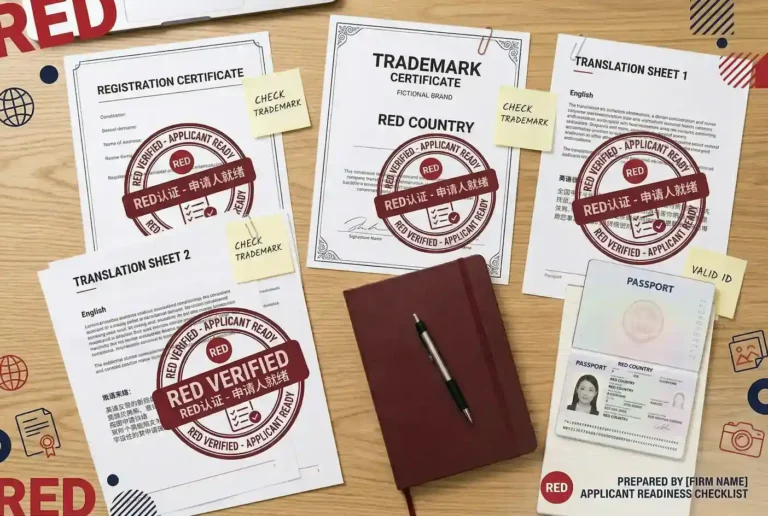
For many brands, a Xiaohongshu business account for foreign companies will require some version of the following:
- company registration certificate or equivalent business registration document
- ID of the legal representative, responsible person, or operator
- operator contact details
- business application letter
- trademark certificate, where branding or naming depends on it
- brand authorization documents, if the applicant is not the trademark owner
- Chinese translation materials for non-Chinese documents where needed
- category-specific licenses for regulated sectors
A practical document-prep table
| Document type | Why it matters | Common issue |
|---|---|---|
| Company registration document | Proves the entity exists | unclear scan, missing pages, mismatch with application details |
| Responsible person / operator ID | Proves accountability | wrong person, expired ID, inconsistent name format |
| Trademark certificate | Supports brand naming | applicant does not own the mark |
| Authorization letter | Bridges entity and brand rights | incomplete chain, vague wording, wrong signatory |
| Translation file | Makes non-Chinese material reviewable | weak translation, inconsistent company naming |
| Industry licence | Required in sensitive sectors | missing, expired, irrelevant to chosen category |
Rule of thumb: if your brand-rights logic takes three paragraphs to explain in email, it is probably too messy to submit casually.
Account naming is not branding freedom in a Xiaohongshu business account for foreign companies application
“We want a cleaner, nicer, more marketable name for Xiaohongshu.”
The platform does not start there. It starts from verification logic. That is exactly why naming issues derail so many Xiaohongshu business account applications.
What usually works
It often needs to be named based on one of these routes:
- the certified company name
- the company shorthand, where supportable
- a registered trademark
- an authorized brand name
- an app name with supporting software proof
- a website name with the right support
- a physical business location, where relevant and supportable
What often gets brands into trouble
The following are frequent risk points:
- trying to invent a catchy nickname with no document support
- using “official account”, “flagship”, “headquarters”, or similar descriptors without proof
- using a distributor account to claim the brand name alone
- choosing a name that imitates platform-official language
- using titles, personal names, or doctor-like identities in sensitive categories
- naming that suggests a broader authority than the entity can prove
A good account name often feels slightly conservative on paper and much stronger in verification. That is usually the right trade-off.
Step-by-step process for a Xiaohongshu business account for foreign companies
I still think the process matters. It just should not be the first thing on the page.
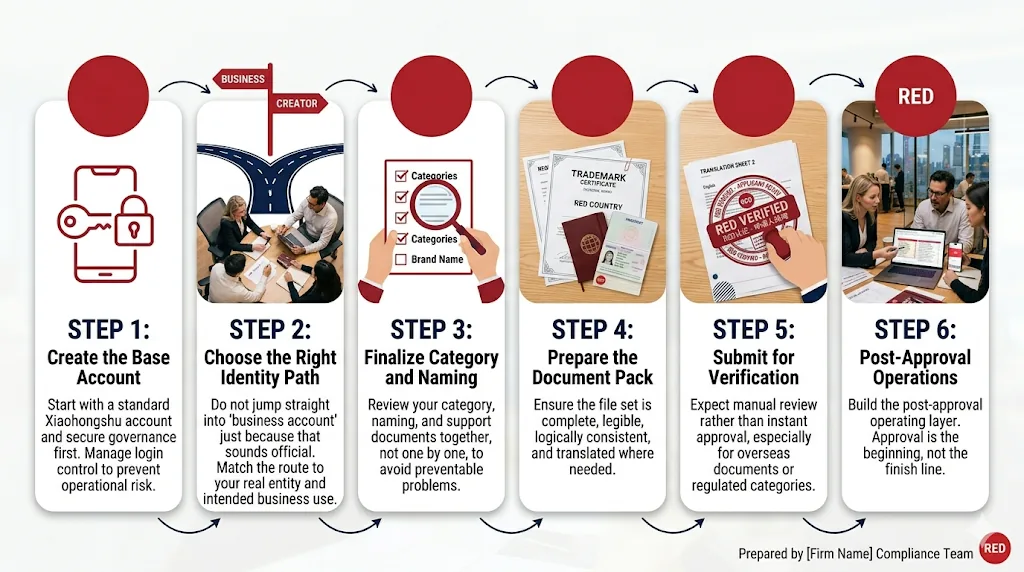
Step 1 — Create the base account
Start with a standard Xiaohongshu account and secure governance first. In any Xiaohongshu business account workflow, login control problems create preventable operational risk:
- who owns the login
- which phone number is used
- which email is tied to the account
- who will manage future access
Step 2 — Choose the right identity path
Do not jump straight into “business account” just because that sounds official. Match the route to your real entity and intended business use.
Step 3 — Finalize category and naming
This is where many avoidable problems start. Your category, naming, and support documents should be reviewed together, not one by one.
Step 4 — Prepare the document pack
Make sure the file set is complete, legible, logically consistent, and translated where needed.
Step 5 — Submit for professional or business verification
Expect manual review rather than instant approval, especially if you are using overseas documents, application letters, or a regulated category.
Step 6 — Build the post-approval operating layer
Approval is the beginning, not the finish line.
Before launch, prepare:
- account positioning
- first content pillars
- moderation and response workflow
- KOC or KOL coordination logic
- lead handover plan
- internal compliance guardrails
What to do after your Xiaohongshu business account application is approved
A verified badge helps, but it does not create trust on its own. The first mistake I see after approval is a generic “We are now on Xiaohongshu” post with no platform-native strategy.
What to prepare instead
Start with searchable content:
- beginner explainers
- comparison posts
- use-case content
- myth-busting content
- category problem posts
- brand-proof content
- scenario-based recommendations
Why this matters
Chinese users do not reward lazy localization. They compare, save, search, and question. If your account looks verified but empty, or official but irrelevant, you lose momentum fast.
That is why a Xiaohongshu business account for foreign companies only becomes commercially useful when it is connected to:
- good localization
- useful first content
- comment and DM handling
- lead capture or e-commerce logic
- a realistic China entry plan
❓ Frequently Asked Questions
My final recommendation on a Xiaohongshu business account
If your category is mainstream, your documents are clean, and your brand-rights logic is straightforward, a Xiaohongshu business account is often a workable step. In those cases, a Xiaohongshu business account for foreign companies can move from paperwork to practical brand-building relatively smoothly.
If your category is sensitive, your structure is unusual, or your naming and trademark logic are messy, do not pretend this is just admin. Treat it as a gatekeeping decision.
Ready to localize your 2026 recruitment strategy? → Book your free China marketing consultation with Twish



One Comment