How to Use WeChat for B2B Lead Generation in China
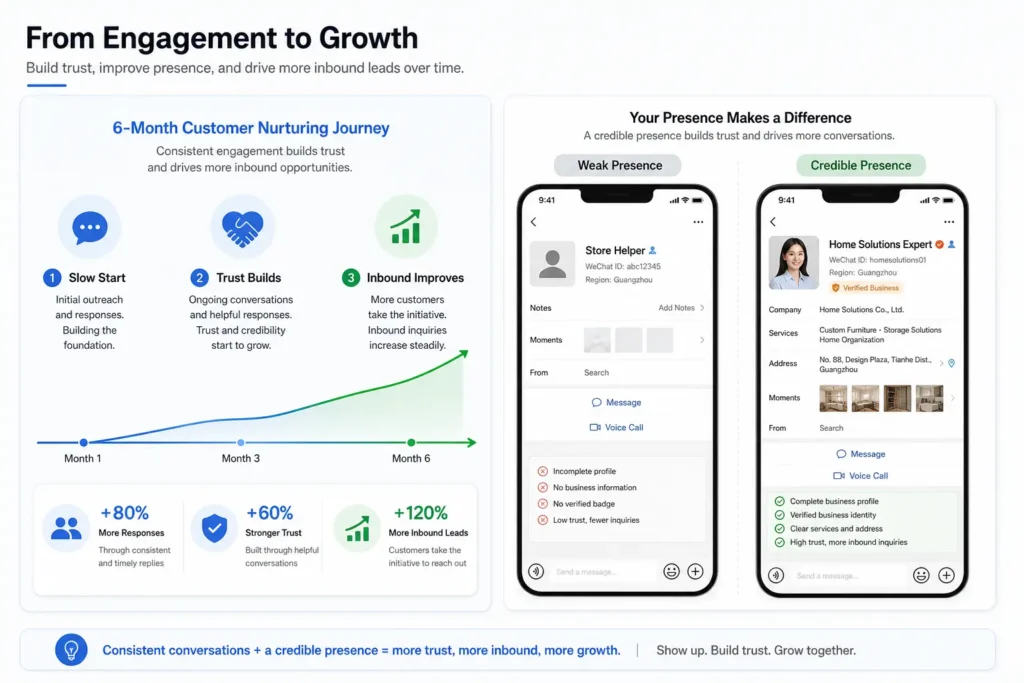
At first, many foreign teams find it frustrating because the response feels slow. It does not usually deliver instant sales, it rarely behaves like a fast paid channel, and it can feel underwhelming if you judge it too early. But if you understand what it is actually for, you also realize why it cannot be skipped. Six months later, most serious teams do not say, “We started too early.” They say, “We should have started earlier.”
That is because WeChat is not just another social account in China. For B2B brands, it often works as a credibility layer, an education layer, and a conversion layer at the same time. It is where Chinese prospects check whether you are active, whether your point of view is useful, and whether there is a real path to reach someone. It may not create demand from nothing, but it can turn weak interest into trust and trust into usable inbound conversations.
WeChat for B2B in China is a lot like website SEO.
Quick answer: is WeChat actually good for B2B lead generation in China?
Yes, but not in the way many foreign brands expect.
If you are hoping WeChat will behave like a top-of-funnel lead machine and drive immediate B2B sales on its own, you will probably be disappointed. In most categories, it is not the first place demand starts, and it is rarely the fastest route to revenue. But that does not make it unimportant. It makes it easy to misunderstand.
What WeChat does well is something more durable. It helps B2B brands in China build visible credibility, educate buyers over time, create a reliable contact path, and support inbound lead handling once interest already exists. In other words, WeChat is often less like a performance ad channel and more like your credible website in China. The difference is that in China, this “website” lives inside the ecosystem people already use every day.
That is why I would not ask, “Can WeChat generate B2B leads by itself?” The better question is: where does WeChat fit inside a China B2B lead-generation system? Once you frame it that way, its value becomes much clearer.
For a broader strategic view, you can also read what WeChat is still good for in 2026.
A clear decision framework: when to start with WeChat vs other channels
| Situation | Start with WeChat | Start with Baidu / Events / Partner Distribution / PR |
|---|---|---|
| Manufacturing and industrial brands with technical products | Yes, if WeChat is used as the online trust and follow-up layer after meetings, exhibitions, and distributor conversations | Events, PR, and channel relationships usually create demand first |
| Exhibition-driven B2B sectors | Use WeChat as the online continuation of offline trust | Events and campaigns should usually lead |
| Financial and legal services | Yes, especially for policy interpretation, credibility, and consultation paths | PR can still support awareness, but WeChat is often a strong owned channel |
| SaaS and cloud services | Yes, as a China-facing content hub for product education, case proof, and inbound lead capture | Partner distribution and search may still help demand generation, but WeChat should exist early |
| SME advisory services such as tax, HR, and consulting | Yes, because useful content can directly demonstrate expertise | PR is useful when there is a known target network, but WeChat can still be a core owned channel |
| Commercial consulting, property consulting, company setup services with a known partner list | Sometimes later | PR-first or network-led outreach often makes more sense as an initial test |
| Agricultural products, raw materials, and distribution-led categories | Usually not first | Partner distribution and buyer network development tend to drive sales faster |
| High-ticket consumer products using B2B or retail networks | Use WeChat mainly for branding, trust, and SCRM support | Offline retail, distributors, and store networks normally matter more for sales |
| Green tech / environmental / government-adjacent sectors | Usually not first | Events, PR, and institutional relationships tend to matter more than WeChat-led market expansion |
Where WeChat fits in a real China B2B funnel
If you expect WeChat to act like a top-of-funnel growth engine for B2B in China, you will almost always overestimate what it can do. In most serious B2B categories, WeChat is not where demand starts. It is where credibility compounds, education happens, and inbound interest becomes usable. That is the real role it plays.
For many foreign teams, this is the mental shift that matters most. In Western B2B, marketers often think in terms of email capture, nurture sequences, gated PDFs, and website-first conversion. In China, the logic is different. Buyers may discover you through events, PR, partner introductions, search, or industry networks.
But once they want to verify whether your company is real, useful, and worth engaging, WeChat often becomes the trust layer they check next. That is why I usually describe WeChat as your closest equivalent to a “credible website in China” rather than a standalone lead machine.
For manufacturing and industrial brands
WeChat works well as an online continuation of offline trust-building. If your market still depends on exhibitions, distributor meetings, factory visits, and relationship-led selling, WeChat should support those interactions rather than replace them.
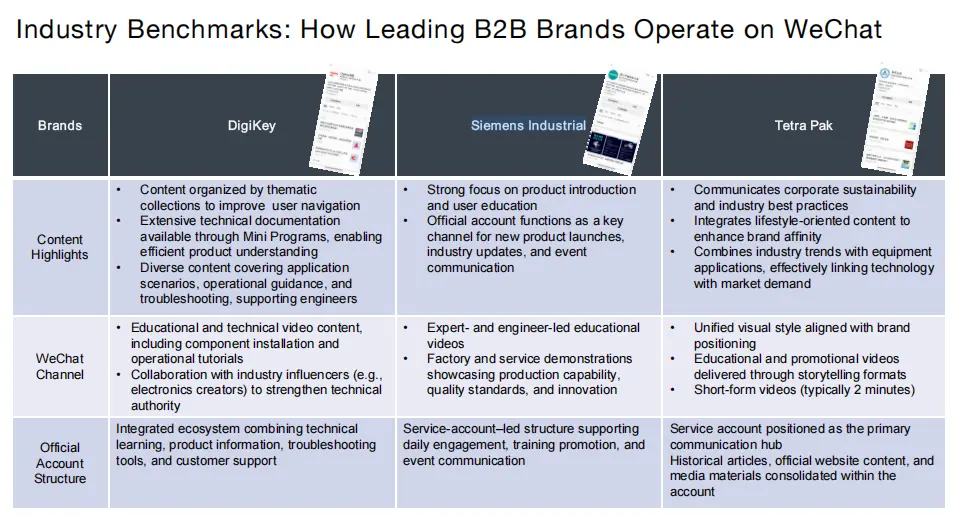
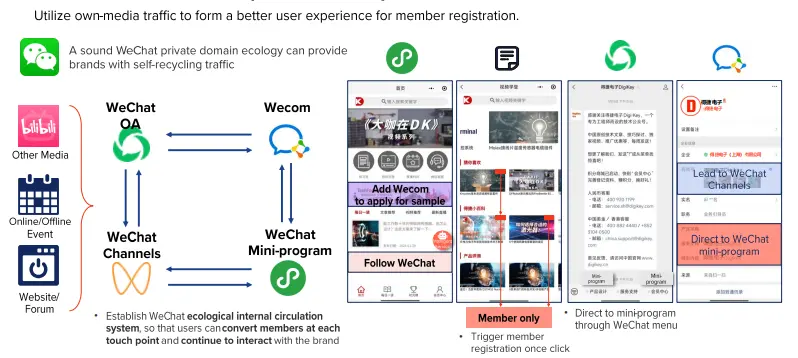
Brands like Tetrapak, Siemens, and DigiKey all show versions of this pattern: content is used to make technical products easier to understand, keep buyers engaged after first contact, and support follow-up conversations. In China, even heavy industrial brands can use WeChat well when they publish equipment operation guides, case videos, and use-case explainers. SANY, for example, has used practical equipment content to reinforce authority instead of relying on generic corporate messaging.
For financial and legal services
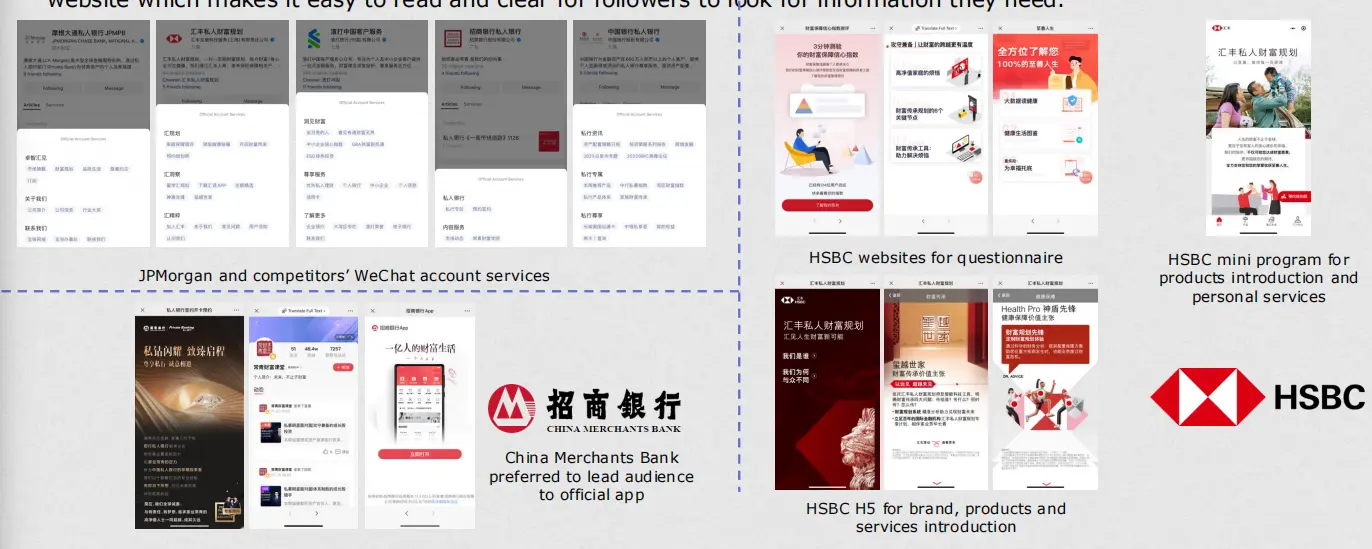
WeChat often performs best as a professional trust and education channel. High-net-worth asset management, insurance, tax, and legal advisory businesses usually depend on continuity, confidence, and repeated exposure to expert judgment. In those sectors, the goal is less about instant lead capture and more about building a credible voice people are willing to consult.
A corporate account that regularly publishes policy interpretation, tax updates, or market commentary can strengthen client stickiness over time. A useful model here is to combine expert content with low-friction consultation paths, such as a mini program or lightweight inquiry tool, instead of pushing all users straight into a hard sales conversation.
For enterprise services (SaaS and cloud solutions)
WeChat should usually function as a localized content-and-proof hub. The decision cycle is long, the product is rarely self-explanatory, and the buyer often needs repeated education before becoming sales-ready. In that context, WeChat is useful because it can host technical explainers, white paper breakdowns, industry solution content, and customer proof in one familiar environment.
This is similar to how Alibaba Cloud has used technical white papers and industry-specific solution content to attract enterprise interest. If you are a SaaS company, the most useful mindset is often: treat WeChat like your China-facing website, not your demand-gen shortcut.
For SME-facing advisory services
Tax agents, HR consultants, recruitment specialists, marketing strategists, and training providers, WeChat can be even more practical. These businesses often sell through expertise and repeat usefulness. A finance consultancy can publish tax-saving tactics and policy interpretation.
An HR service can post hiring strategy and employee management guidance. A marketing consultancy can use cases, frameworks, and tool recommendations to show how it thinks. In these categories, WeChat can attract inbound leads because the content itself demonstrates competence.
When WeChat should not lead the funnel.
In exhibition-heavy B2B sectors, I would not usually recommend building a long-term WeChat content program first and hoping it creates demand from scratch. The stronger path is often PR, events, and campaign activity first, with WeChat acting as the online credibility layer that supports follow-up.
In commercial consulting, real estate consulting, and company setup services, if you already have a defined partner list or target network, PR-led exposure and reputation-building may be a better first test than heavy WeChat investment. In agricultural products, raw materials, or goods like tomato paste, distribution and partner relationships often drive sales faster than content-led WeChat efforts.
The same is often true for high-ticket consumer products above roughly CNY 5,000, such as custom furniture: if the goal is sales, partner channels, retail, and offline networks usually matter more; if the goal is branding, WeChat can still help, but it should not carry unrealistic sales expectations.
There are also sectors where WeChat is simply too weak as a market-opening tool. In green technology, environmental services, and some government-adjacent sectors, trust is often shaped more by events, institutional networks, PR, and policy visibility than by social content. In those cases, WeChat may still be useful later, but it is rarely the best first lever for expanding the market.
So the practical funnel is usually not “open a WeChat account and generate leads.” It is closer to this:
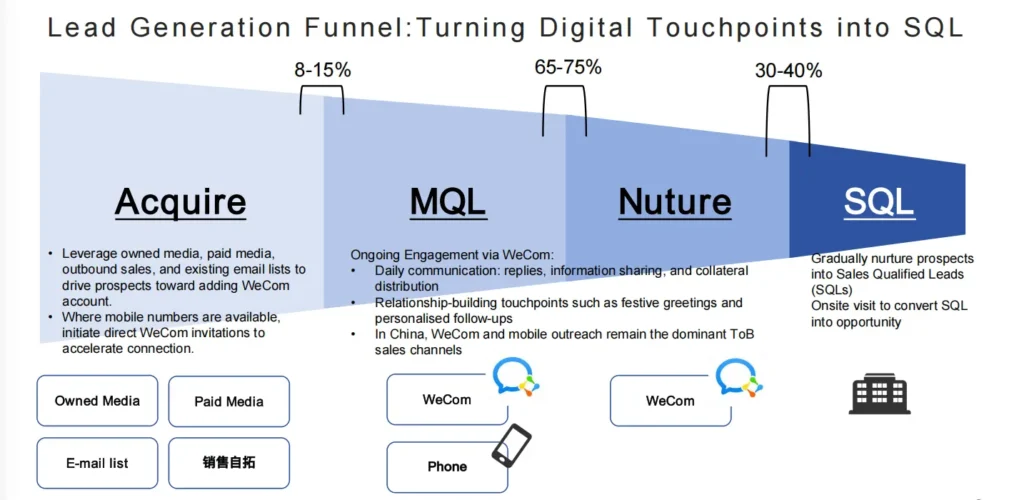
PR / events / search / partner exposure / useful content -> WeChat for credibility and education -> WeCom or structured consultation -> sales follow-up
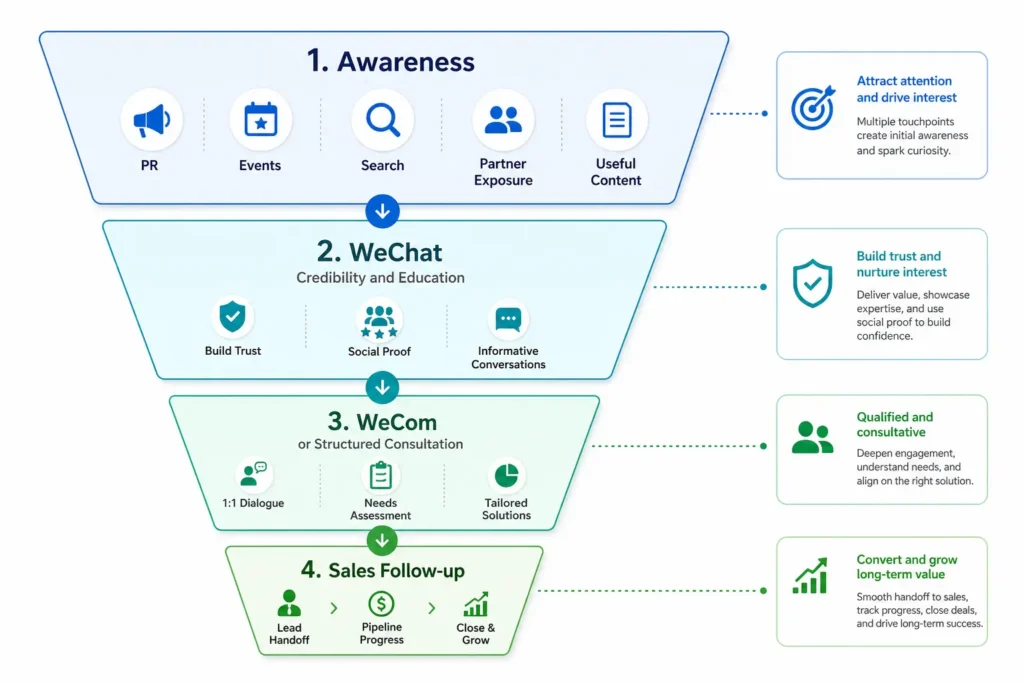
That is why I would frame WeChat this way for B2B brands entering China: not a top-funnel engine, and not an immediate sales machine, but your most credible owned environment for branding, inbound leads, and content education once real market interest starts to form.
The minimum viable WeChat lead-generation stack
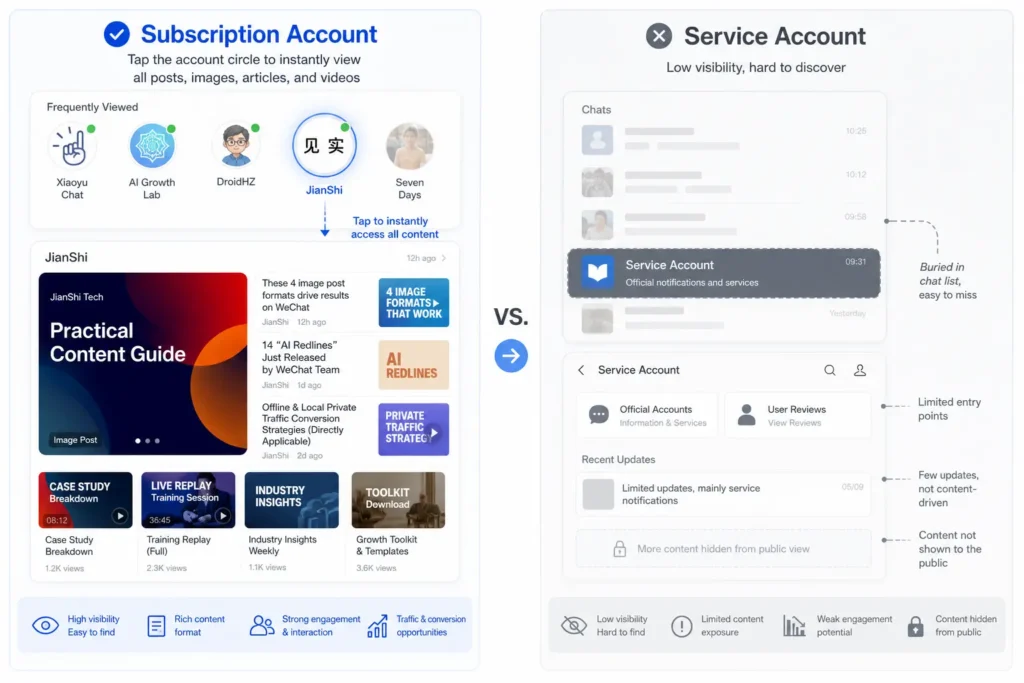
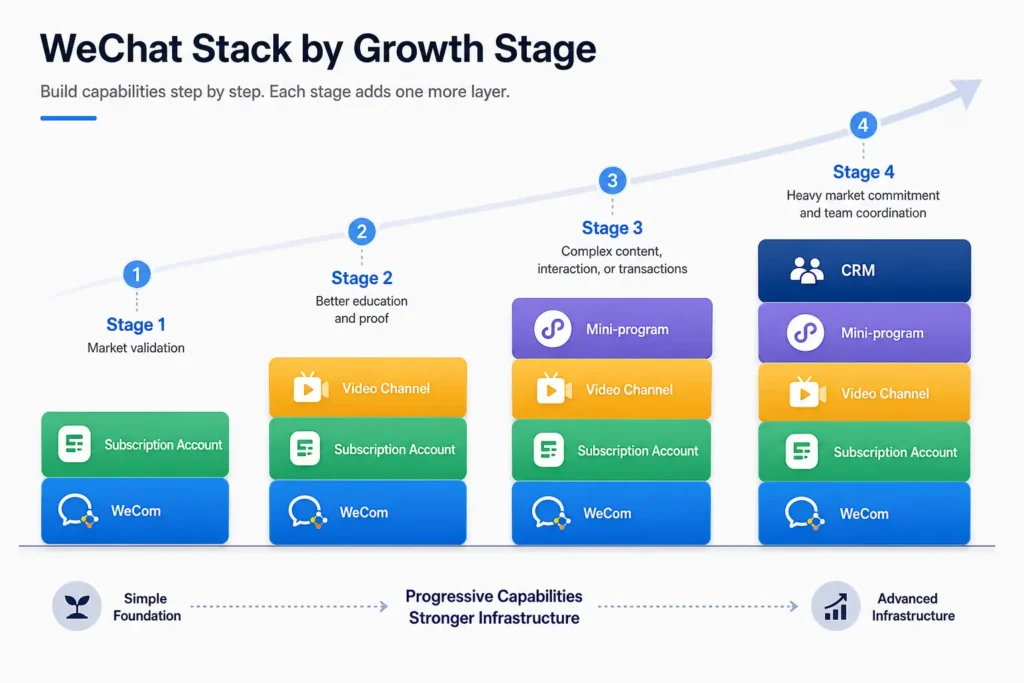
For most B2B brands entering China, the minimum viable WeChat lead-generation stack is much simpler than teams expect. In 2026, Subscription Account + WeCom is usually enough to start.
That is the setup I would recommend for most companies unless they already know they need heavier infrastructure. The reason is practical, not theoretical. A lot of foreign teams still assume they should open a Service Account by default because it sounds more official or more powerful. But in practice, Twish does not usually recommend Service Account first in 2026 unless the brand has a clear need for deeper functionality.
The core problem is visibility. Service Accounts are now buried so deeply inside WeChat that normal content publishing often gets very weak day-to-day reach. Subscription Accounts are not perfect either, and yes, they are folded into the subscription folder, but they still function more like an ongoing content column. For B2B brands that need to publish industry insights, use cases, product education, and proof-of-work consistently, that is usually far more useful. In other words, if your goal is to build trust through regular content, Subscription Account is often the better public-facing content layer.
If a company insists on using a Service Account, there are still ways to make it more useful. One is to rely more on richer content units such as image-led posts and more public-feed-like formats, rather than expecting standard article pushes to do all the work. But even then, my default view is the same: put heavy functionality into WeCom or a mini-program, not into the Service Account itself.
A slightly more advanced version of the stack is: Subscription Account + WeCom + Video Channel
That setup is often enough for brands that need better product demonstration and trust-building without jumping straight into expensive builds. Video Channel can be especially useful for products or services that benefit from showing process and proof rather than just explaining them in text. That can include product walkthroughs, usage guides, case examples, factory content, service explanations, or short expert-led commentary. For industrial, enterprise, and technical businesses, this matters because many buyers trust what they can see made tangible.
Mini-programs should come later, and only when the business actually needs them. The right trigger is not “we want to look advanced.” The right trigger is “our content or conversion flow has become too complex for article-based navigation alone.”
A mini-program starts to make sense in at least three situations.
First, when the product library, toolset, or information architecture is too rich for a normal Official Account flow. DigiKey is a good example of the kind of case where article-led publishing alone is not enough. If a user needs calculators, product selection logic, or access to very large numbers of parts and specifications, pushing everything through WeChat articles becomes inefficient very quickly.
Second, when the brand needs interactive education or engagement. If the goal is not only to inform but also to guide, test, or qualify users through a structured experience, mini-programs are much stronger. This is especially true when education is part of conversion. Boehringer Ingelheim, for example, has used mini-program formats for pet health education, including interactive quiz mechanics. That kind of structured interaction is hard to deliver cleanly through standard account content alone.
Third, when the use case involves transactions or service workflows. Localized hotel booking is a clear example: if the user needs to browse, choose, and complete a booking flow, a mini-program is a much better format than an article plus multiple redirect steps.
When it comes to lead capture itself, I would generally avoid sending users to a random external landing page if a WeChat-native option is available. The reason is simple: friction and reliability.
External pages often create problems inside WeChat. Sometimes the page layout does not adapt properly in the in-app browser. Sometimes forms are awkward to complete on mobile. And sometimes the website itself loads badly or fails because of China network constraints. When that happens, you do not just lose convenience, you lose the lead.
That is why a low-friction option inside the WeChat ecosystem is usually stronger. The cleanest setup is often WeCom with embedded forms that can feed directly into CRM, or at least into a structured internal follow-up flow. Even lightweight tools such as WeChat-native survey or questionnaire links can work better than pushing users to an external website too early. A native or near-native form inside the ecosystem is usually more reliable and easier for users to complete, as long as it is tested properly in advance.
CRM integration is another area where teams overbuild too early. Not every B2B brand entering China needs a heavy CRM project from day one.
So if I had to summarize the minimum viable stack by stage, it would look like this:
- Stage 1: Market validation
Subscription Account + WeCom - Stage 2: Better education and proof
Subscription Account + WeCom + Video Channel - Stage 3: Complex content, interaction, or transactions
Add mini-program - Stage 4: Heavy market commitment and team coordination
Add stronger CRM integration
That is the real logic. Start with the system that supports credibility, education, and usable follow-up. Add complexity only when the business model actually needs it. If you need more operational setup context, see our WeChat marketing guide for SMEs.
What content actually generates qualified B2B leads on WeChat
A lot of B2B teams assume that if they publish often enough on WeChat, leads will eventually come. That is not how it works.
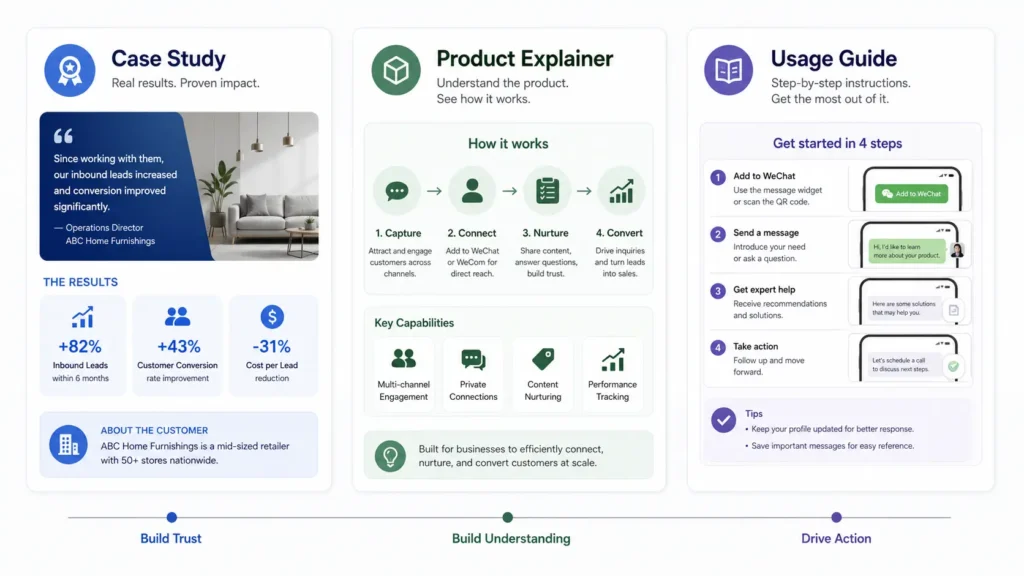
In practice, the content that brings the best-quality inbound leads on WeChat is usually much more concrete. The formats that tend to work best are case-led content, product explanations, and product usage guides. These formats help buyers understand not just what a company does, but how the solution works, where it fits, and whether it is relevant to their own situation. That matters because most serious B2B buyers in China are not looking for entertainment. They are trying to reduce uncertainty.
A strong case study works because it gives proof. A clear product explainer works because it removes confusion. A usage guide works because it helps the buyer imagine implementation, not just purchase. Those are the kinds of assets that move someone from curiosity to credible interest.
By contrast, some content formats look valuable on paper but do not always produce the strongest lead quality on their own. White papers and founder-opinion content can still play a useful role, especially for authority-building, but in many cases the lead quality they generate is only moderate unless they are tied closely to a concrete business problem. On their own, they can be too abstract, too top-of-funnel, or too detached from the buyer’s immediate decision.
That is why I would not judge WeChat content by how polished or “thought leadership” driven it feels. I would judge it by whether it helps the right buyer answer questions like:
- Is this relevant to my company?
- Does this team understand my problem?
- Can this product or service actually be used in my setting?
- Is this worth a conversation?
One of the biggest problems for foreign B2B brands is that their WeChat content is often still written for an overseas narrative, not for the actual scenarios, pain points, and decision logic of the Chinese market. Even when the translation is technically correct, the story still feels imported. The content talks about the product the way global headquarters wants to describe it, instead of the way Chinese buyers evaluate it.
And if you do not localize the product story and narrative properly, Chinese customers usually will not buy in.
That does not only mean translating language. It means localizing the frame. What use case matters here? What pain point is the customer trying to solve in China? What proof do they need? What would make them trust that this solution is usable in their market conditions, with their internal stakeholders, and with their operational constraints?
So the real goal of WeChat content is not simply to keep publishing. It is to publish material that makes your offer easier to understand, easier to trust, and easier to picture in a Chinese business context.
That is why the most effective B2B WeChat content is usually not the most generic or the most frequent. It is the content that connects product + use case + local narrative clearly enough that the buyer feels ready to ask the next question.
If your team is benchmarking who can execute this kind of system well, our article to the best China B2B marketing agencies for WeChat and lead generation offers a useful comparison point.
How to qualify leads instead of collecting junk contacts
One mistake I see often in China B2B programs is that teams talk about “lead generation” as if collecting contact details is already the hard part. It usually is not. The harder part is deciding what happens next.
For most B2B brands, especially those selling technical, high-consideration, or long-cycle solutions, lead quality is not something marketing should fully define alone. The actual sales team will always have the final view on what counts as a real opportunity. Because of that, I do not think the smartest role for a marketing team or agency is to pretend it can perfectly judge every lead in isolation. The more useful role is to design a practical first-layer qualification and routing system that helps the company respond faster and waste less time.
In WeChat ecosystems, WeCom is usually the most practical tool for that first layer.
A simple but effective model is to create a marketing coordinator or marketing lead handler role inside WeCom. That person is not the final sales owner. Their job is to receive inbound interest first, collect the most important initial information, and apply a basic internal triage rule before passing leads to the appropriate sales contact.
In practice, this means the company creates an internal grading logic, often something as simple as A / B / C lead levels, based on its own standards. The criteria can include budget range, project timeline, industry relevance, or whether the prospect matches the company’s target customer profile.
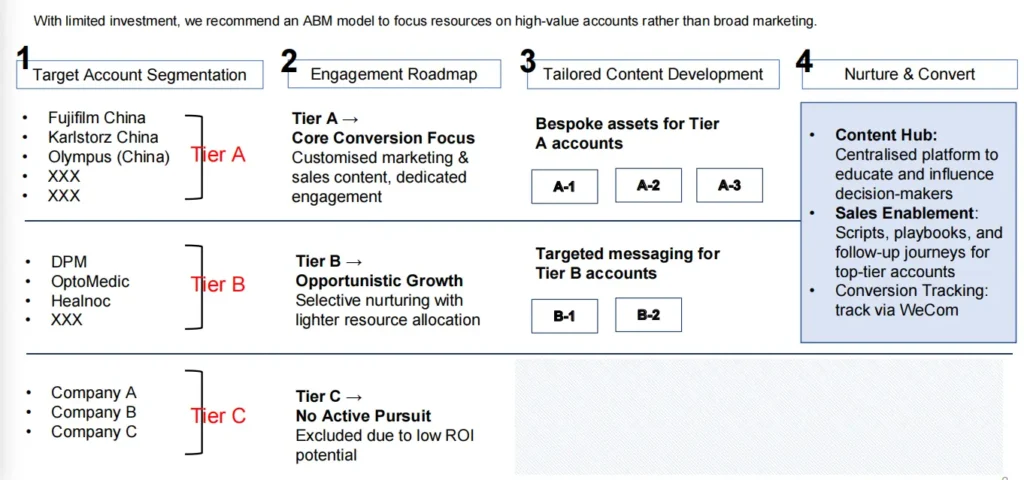
In some cases, urgency or region can also matter. The exact thresholds should still come from the client’s own business reality, but WeCom can make the handoff process cleaner because the first receiver does not need to “sell” immediately. They just need a clear routing standard.
This matters because B2B selling in China still depends heavily on human follow-up. If every inquiry goes straight to a salesperson with no structure, good leads get missed, weak leads waste time, and internal ownership becomes blurry. But if a first-line marketing role receives the inquiry, tags it, and routes it based on agreed rules, the system becomes much easier to manage.
At the minimum, WeCom should help capture a few core fields early:
- mobile number
- company name
- job title
- project type or stated need
These are usually enough to support initial routing. If the company wants to push data into CRM later, then collecting a company email can also be useful. But I would not force too many fields too early, because every extra step creates more friction.
From a process perspective, it is useful to think in stages. The first inbound contact is simply a marketing lead. If that inquiry matches basic routing standards, it can then become a marketing qualified lead (MQL) and be passed to the relevant salesperson or team. If sales later decides the lead is not a fit, the lead should not disappear. It should be returned to a shared pool or public queue for further review, future nurture, or reassignment.
We have used this kind of grading logic in WeCom before, and it works well when a company is serious about lead ownership. But I would also be careful not to overengineer it too early. A full classification and routing system can take real time and money to build well. If the company is still at an early stage, it is often better to start with a manual allocation model first, then add more workflow complexity once inbound volume and sales coordination justify it.
For that reason, I would frame WeChat lead qualification this way for most foreign B2B teams: start with simple routing, clear ownership, and a few high-value fields. Let sales define the deeper qualification logic over time.
Common mistakes foreign brands make
One of the biggest mistakes foreign B2B brands make on WeChat is assuming they should measure success the way consumer brands do. That often leads them to chase the wrong signals from the start.
The clearest example is follower growth.
For B2B brands, follower count is usually not the main signal that matters. A serious prospect may never follow your account at all. That does not mean the content failed. In many cases, the buyer simply checks your account when evaluating whether your company is credible, active, and worth contacting. They may not subscribe, but they may still trust you more because the account exists and the content feels legitimate.
That is why I would be careful with any WeChat strategy that overemphasizes audience growth as the headline KPI for B2B. In this context, a smaller audience can still support meaningful pipeline if the content improves trust and makes the next step easier. The goal is not to look popular. The goal is to look real, useful, and contactable.
A second common mistake is making it unnecessarily hard for Chinese prospects to reach the team.
Many foreign brands still place a phone number or a company email address as the primary contact method inside the Official Account. Technically, that looks fine. In practice, it creates friction. Chinese users usually want the fastest possible route to a real person, but that does not mean they want to call you. In many cases, they will not pick up the phone and they will not send a formal email just because they saw a content post.
That is why WeCom is usually a better contact path. Even a WeChat contact card is often more useful than a cold phone number. The expectation in China is not “I will contact you later through formal channels.” The expectation is “I should be able to reach the right person quickly and naturally.” If your WeChat content builds trust but your contact path still feels foreign, slow, or awkward, you are creating avoidable leakage.
The third mistake is narrative arrogance.
This shows up when foreign brands rely too heavily on overseas case studies, or worse, try to make themselves look strong by talking down local competitors and local brands. That approach usually backfires. China buyers do not want to feel that a foreign company is dismissing the local market. They want to feel that the company understands the market, respects local realities, and can operate credibly within them.
If your content constantly uses overseas proof with no local translation of relevance, the message often feels disconnected. And if the tone suggests that local players are backward or inferior, it can come across as arrogant very quickly. That is especially risky in B2B, where credibility is not just about expertise. It is also about judgment.
The better approach is to show respect for the market. Respect the local context. Respect the strength of Chinese brands. Respect the fact that Chinese buyers are evaluating you against local expectations, not only against your global positioning. A confident B2B brand can explain its difference without sounding dismissive.
So if I had to summarize the most damaging foreign-brand mistakes on WeChat for B2B, they would be these:
- treating follower growth as the main success metric
- forcing prospects into phone or email-first contact paths
- publishing with a tone that feels imported, disconnected, or arrogant toward the local market
Fix those three, and the rest of the WeChat strategy usually becomes much easier to improve.
When a 6-week pilot makes more sense than a long retainer
A lot of foreign B2B brands know they should be on WeChat, but they still do not know what the right operating model should be. That is where a 6-week pilot can make more sense than jumping straight into a long retainer.
The main reason is uncertainty. If the company is still testing market fit, still deciding which China channel should lead, or still unsure whether WeChat should act mainly as a credibility layer or as a more active lead-handling channel, a long retainer can lock the team into a structure before the basics are proven. A pilot gives you room to test the practical questions first.
For most B2B teams, the right pilot questions are not “Can we publish content?” They are:
- What content angle actually gets qualified attention?
- Does WeChat improve credibility enough to support sales follow-up?
- Is WeCom handoff working in practice?
- Are inbound contacts usable, or just noisy?
- Does the company need only a lightweight stack, or something more advanced?
That is why I usually see a pilot as the smarter option when a brand is entering China, relaunching its WeChat presence, or trying to connect marketing activity to a real lead-management workflow for the first time.
A good 6-week pilot should test a small but meaningful system:
- one clear target audience or segment
- one content narrative or offer
- one WeChat setup path
- one lead-routing and follow-up model
- one measurement framework focused on lead quality, response speed, and early conversion signals
If those signals are weak, the team learns before overcommitting. If they are promising, then a longer retainer becomes much easier to justify because the operating model is already grounded in evidence.
In that sense, a pilot is not a smaller retainer. It is a way to reduce waste and make the long-term decision smarter. If you are evaluating execution partners at this stage, our WeChat marketing services page is the best place to understand how Twish approaches this kind of testing.
❓ FAQ: WeChat B2B lead generation in China
Conclusion
WeChat B2B lead generation in China is rarely about speed. It is about turning market interest into trust, education, and usable inbound conversations. If you treat WeChat like a top-funnel growth hack, you will likely be disappointed. If you treat it like your China-facing credibility and conversion layer, it becomes much easier to use well. The brands that benefit most are usually not the ones who expect instant results. They are the ones who start early, localize properly, and build the right minimum system before scaling.
If you are unsure whether WeChat should play a credibility role, a lead-routing role, or both in your China strategy, book a WeChat lead-generation feasibility review or talk to Twish about a 6-week China B2B pilot focused on lead quality, follow-up workflow, and conversion design.
One Comment