Why a WeChat Account Can Look Active but Still Fail to Build Trust
Some foreign brands post regularly on WeChat and still fail to build trust. The WeChat account is active, the schedule is real, and the content keeps going out, yet the page still feels thin when a Chinese prospect checks it.
That happens because activity and credibility are not the same thing.
In China, a WeChat Official Account often works less like a social feed and more like a living trust page. People do not just want proof that you scheduled content. They want proof that your company is relevant to China, understands the market, and has a believable next step if they want to contact you.
Quick answer: active is not the same as credible
Most brands assume that once the account is verified and publishing, the hard part is done. It is not.
Verification helps. A posting rhythm helps. A clean visual style helps. But none of those things automatically answer the user’s real question: why should I trust this company in the China market?
If the content still feels translated, the examples feel imported, and the contact path feels awkward, regular publishing just makes the weakness more visible.
This is why WeChat should be judged by a different standard. It is not enough to ask whether the team is posting. The better question is whether the account gives a Chinese buyer enough reason to believe the brand is real, useful, and reachable.
That is also consistent with Twish’s broader view in What WeChat Is Still Good For in 2026: WeChat is still valuable, but mainly as a credibility and conversion layer, not a growth engine by itself.
What Chinese users actually check on a WeChat account
When someone opens a WeChat account, they are rarely making a formal checklist. But they are still judging a few things quickly.
First, they check whether the account looks legitimate. Verification matters here, because an unverified account can feel unfinished or temporary.
Second, they check whether the content is recent. An abandoned account creates doubt fast. If nothing has moved in months, users may assume the company is not active in China or is no longer investing in the market.
Third, they check whether the content feels relevant. This is where many foreign brands lose trust. The account may be active, but if the posts still read like global content copied into Chinese, the user does not feel understood.
Fourth, they check whether there is a clear contact path. In B2B and high-consideration categories, Chinese users usually do not care much about follower count. They care whether they can quickly find a real way to reach you. That could mean a WeCom handoff, a WeChat card, a mobile number, or a company email. The important part is not the exact format. The important part is that the route feels direct and usable.
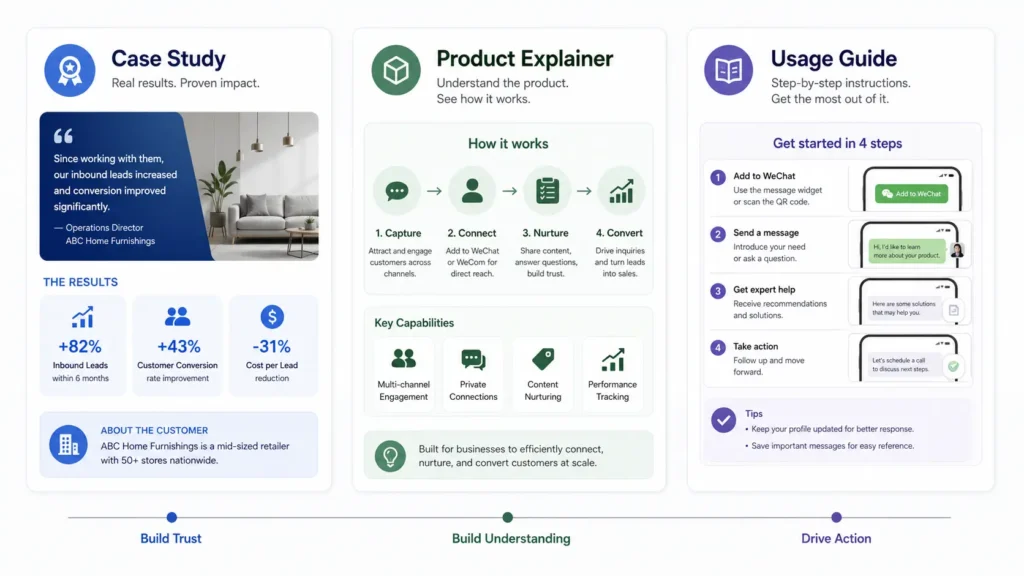
Fifth, they check for proof. Not empty branding, but something concrete: a local use case, a useful point of view, a product explanation that makes sense, or a service process that reduces uncertainty.
Four signs your WeChat account still feels translated
The first sign is that the account relies too heavily on global messaging. If every article sounds like it came from headquarters, the account may be accurate but still feel distant. Chinese buyers want to see how your offer fits their market conditions, not just how your company describes itself globally.
The second sign is that your examples are all foreign. Overseas case studies are not useless, but they are weak as the only form of proof. If the account never shows a China-facing point of view, users may assume the business is not really operating close to their reality.
The third sign is that the content sounds arrogant toward the local market. This is an easy mistake for foreign brands. If the tone implies that local competitors are unsophisticated, or that China simply needs to catch up to a Western standard, trust drops quickly. Brands do not need to flatter the market, but they do need to show they understand it.
The fourth sign is that the account still feels operationally imported. A post may end with a generic external landing page, a form that opens badly inside WeChat, or a contact path that forces too much friction. That makes the company look less prepared than it intended.
Why content cadence alone does not build trust
Consistency matters, but consistency only helps when the content is doing the right job.
Many foreign teams treat WeChat like a publishing calendar problem. They believe that if they just keep feeding the account, trust will slowly appear. In practice, that only works if the posts keep answering useful questions, reflecting real local scenarios, and making the next step easier.
This is why follower growth is often the wrong KPI for B2B. A serious prospect may never follow your account. They may simply check it when they hear your brand name, read two or three articles, look for contact details, and decide whether you feel credible enough for a conversation. The account still did its job.
That is also why WeChat is often compared to SEO. It is slower than teams want, and it rarely produces instant gratification. But over time, a credible account keeps helping buyers verify you. Six months later, many brands realize the problem was not that WeChat was useless. They either started too late or published the wrong kind of content.
What a minimum credible WeChat presence looks like
For most foreign brands, the minimum credible setup is not complicated.
Start with a verified Official Account that publishes consistently enough to show the business is alive. In many cases, a Subscription Account plus WeCom is already enough. In 2026, that is often the cleaner default unless the brand truly needs deeper functions, payments, or complex service flows. If the business needs tools, interactive content, or transaction-heavy journeys, then a mini-program may make sense. But functionality is not the starting point for credibility.
The content itself should do a few simple things well:
- explain the product or service clearly
- localize the narrative to China-based pain points or use cases
- show useful proof, not just slogans
- make the next step obvious
The handoff should also stay inside the ecosystem where possible. A WeCom form, a WeChat card, or another native contact path is usually safer than forcing users onto an external page that may render badly or load unreliably.
For B2B brands especially, the goal is not to make the account look impressive. The goal is to make it easy for a serious prospect to think, this company looks real enough to contact.
For operational detail, the next-step setup logic is already covered in How to Master WeChat Account Management for SMEs and How to Use WeChat for B2B Lead Generation in China. The real issue here is not mechanics. It is whether the mechanics are supporting trust.
WeChat is a credibility layer, not just a publishing channel
Twish POV
The mistake is not that foreign brands use WeChat. The mistake is that they often use it too narrowly.
If you treat WeChat as a place to dump updates, the account may stay active while trust stays flat. If you treat it as your China-facing credibility layer, the standard changes. Every article needs to help a user verify something: that you understand the market, that your offer makes sense locally, that there is a human path behind the content, and that the brand is serious about being present.
That also means not every piece of content needs to be dramatic. In fact, many of the most useful posts are practical ones: product explainers, service details, local point-of-view articles, use cases, or common buyer questions. They do not look exciting from a social-media perspective, but they often work well from a trust perspective.
For brands that are still deciding how WeChat should fit into their China presence, the better question is not “Are we posting enough?” but “If a prospect checks our account today, do they have a clear reason to believe us?”
Conclusion
A WeChat account can look active and still fail to build trust when it proves only that content is being published, not that the company is credible in China. If the account still feels translated, generic, or hard to contact, activity alone will not fix it. The goal is a WeChat presence that feels local, useful, current, and reachable.
Book a WeChat feasibility review or talk to Twish about a 6-week China B2B pilot if you want to assess whether your account is building trust or simply staying busy.