How Universities Attract Chinese Students on Xiaohongshu: A Practical 2026 Guide
Author: Chelsea Chang
How universities attract Chinese students on Xiaohongshu is now a core question for international recruitment teams — and as of 2026, the digital landscape has shifted decisively from broad awareness to deep trust-building. Many foreign institutions still rely on websites, email campaigns, education fairs, and agents, but Chinese students and parents increasingly make early decisions through content platforms first. That shift creates a hard challenge: your school may be academically strong, but if your message does not fit Chinese platform behaviour, you remain invisible.
Editor’s Note: In China, trust is built through lived experience, peer validation, and fast interaction — not through official claims alone. Competition is intense, families compare options quickly, and decision cycles run six to twelve months. Policy sensitivity and compliance pressure mean that even well-executed campaigns can fail if conversion design is not carefully managed.
In this guide, you will find a practical framework for building a compliant Xiaohongshu strategy for student recruitment — from positioning and account setup to KOC collaboration, enquiry handling, and performance tracking. You will also learn when Xiaohongshu should lead, when WeChat should convert, and how to avoid common mistakes that waste budget and damage credibility.
Executive Summary: Key Takeaways
- Trust is Currency: In 2026, Chinese families value “lived experience” over “official brochures.”
- The “1+N” Strategy: Use 1 official account for authority and N student creators (KOCs) for social proof.
- Conversion Funnel: XHS for Discovery, WeChat for Consultation, Official Site for Application.
- Compliance First: Strictly avoid “guaranteed admission” claims to maintain account health.
1. Why This Strategy Matters in 2026
China student recruitment is no longer a translation project; it is an ecosystem integration problem. Most Western institutions still struggle with three invisible barriers:
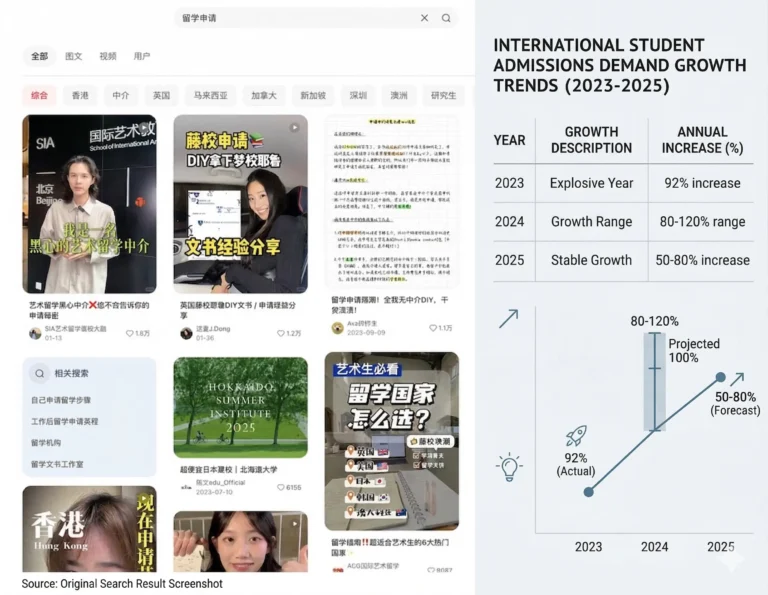
- Platform Logic: XHS is a “lifestyle search engine.” Users don’t just browse; they search for specific pain points (e.g., “Scholarships for UK postgrads”).
- Validation Loop: Students cross-check official claims against comment sections and real student posts.
- Response Speed: The “Golden Hour” rule applies. A delay of 24 hours in DMs often results in losing a high-intent lead to a faster competitor.
2. Dual-Track Decision Making
To succeed, your content architecture must address two distinct audiences simultaneously:
| Feature | Prospective Students | Parents |
|---|---|---|
| Primary Interest | Campus culture, city life, social clubs | Safety, global ranking, employability |
| Success Metrics | “Can I see myself living there?” | “Is this a safe/valuable investment?” |
| Content Hook | Vlogs, student testimonials, food/events | Accreditation, career stats, support services |
💡 Pro Tip: Tag your posts clearly. Use #StudyAbroad for students and #GlobalEducation or #FuturePlanning for parents.
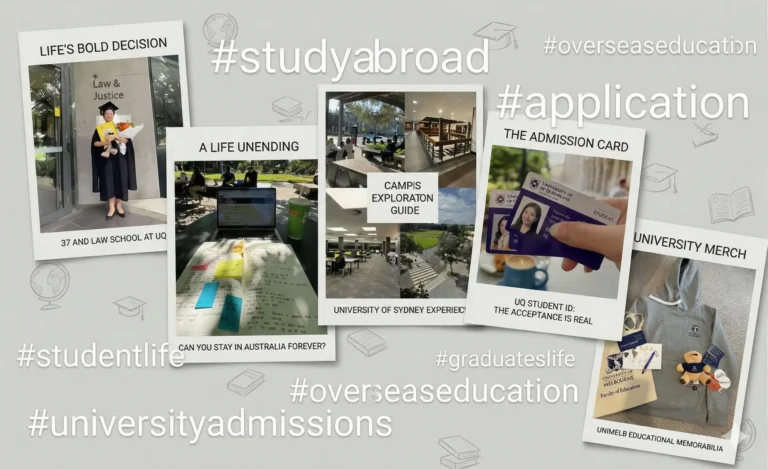
Step-by-Step Framework for University Recruitment on Xiaohongshu(RedNote)
Step 1: Define Positioning for Students and Parents Separately
Don’t just be “University X.” Position yourself as “The most supportive [Subject] hub for international students in [City].” Build two parallel value narratives:
- Students care about learning experience, campus culture, internships, city life, and support services
- Parents care about safety, total cost, graduate outcomes, accreditation, and institutional reliability
Keep both narratives fact-based and consistent with official policy language.
Step 2: Build a Compliant Official Account Foundation
Your profile is your first trust signal. Keep it formal, transparent, and institution-led.
| Element | What to do |
|---|---|
| Account Name | University name + China admissions keyword |
| Bio | School type, study levels, official value statement, approved contact route only |
| Profile Image | Real campus visual — no sales-style creative, no personal recruiter persona |
| Compliance | No phone numbers, QR codes, or unapproved external contact hooks in the profile |
Avoid risky claims like guaranteed admission or guaranteed employment. Use content collections to organize key themes: application guides, program breakdowns, campus updates, and event notices.
Step 3: Content Architecture — The 6-3-1 Rule
Match your content mix to how Chinese students actually search and decide.
- 60% Educational — Deadlines, entry requirements, tuition, scholarship rules, visa guides
- 30% Experiential — Student vlogs, faculty interviews, campus life, city highlights, “hidden gems”
- 10% Interactive — FAQ live streams, open day invitations, downloadable official materials
This balance builds credibility without becoming over-promotional. In practice, two to three posts per week works well, and keeping your content pillars stable for at least eight to twelve weeks before making major format changes gives the algorithm time to work.
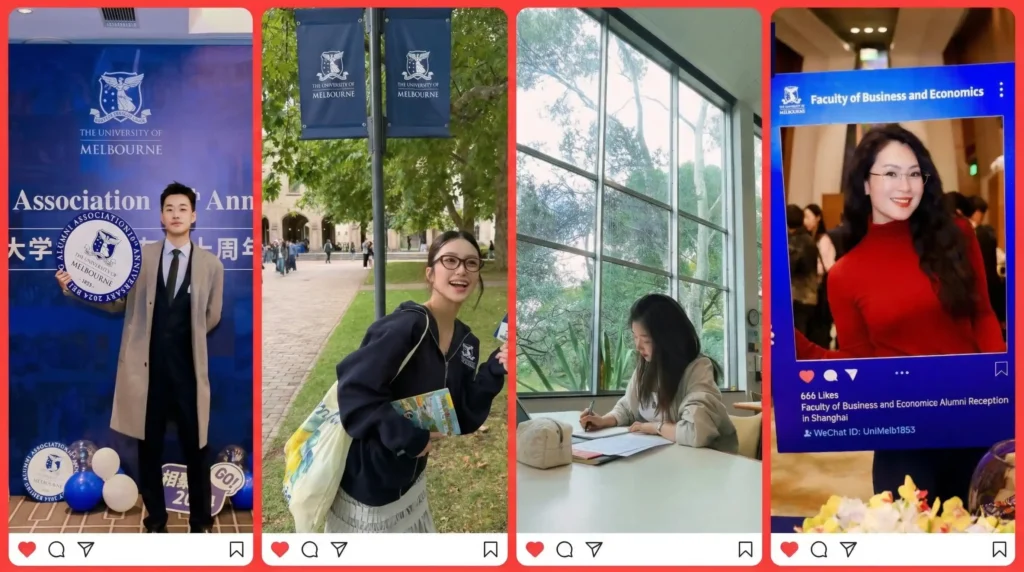
Step 4: Add a KOC Layer for Social Proof
KOCs (Key Opinion Consumers) are not influencers. They are real students, alumni, and parents with trusted peer voices.
Focus on micro-creators in the 1,000–10,000 follower range — their engagement rates in the education niche are often three times higher than larger accounts. One to two posts per month per contributor is enough to test quality without overcommitting.
- Current students — day-in-the-life content, application experience
- Alumni — career outcomes, honest retrospectives
- Parents — safety, value, and peace-of-mind perspectives
Step 5: Run Low-Risk Paid Testing
Start small and promote credibility, not urgency. A common pilot range is CNY 3,000–5,000 over 2 to 4 weeks, using Juguang(Aurora) targeting tools. Promote official posts only — not aggressive lead hooks.
Target users who have searched “Study abroad [Your Country]“ in the last 30 days, and segment by intent:
- Undergraduate prospects and parent clusters
- Postgraduate and early-career clusters
- High-intent users actively researching study-abroad options
Step 6: Convert Through Official Channels — Not Shortcuts
Keep every conversion step compliant. When enquiries come in, follow this triage SOP:
- Comment reply — Friendly, public acknowledgment within hours
- DM triage — Ask for study level and intended major to qualify the lead
- Official handoff — Provide a WeChat QR code or official registration link
- Admissions follow-up — Pass qualified leads to the admissions team with context
- Status logging — Record outcome to close the loop between social and admissions
Field data suggests faster DM response can improve conversion rates by around 20%. Speed signals seriousness.
Step 7: Optimize Weekly, Review Monthly
| Weekly checks | Monthly reviews |
|---|---|
| -Content performance and engagement quality -Enquiry volume and response speed -Recurring objections or questions to address in future content | -Source quality by content type -Application-stage progression from XHS leads -Budget efficiency and cost per qualified enquiry -Message gaps where competitors are stronger |
On Xiaohongshu, a Save is a stronger intent signal than a Like — track save rates and share rates as your primary content performance indicators. Remove low-trust formats and double down on high-intent topics.
Platform Synergy: The “China Digital Loop”
Xiaohongshu does not exist in a vacuum. It is the top of your funnel.
- Xiaohongshu: The Discovery Engine. Where “Search” meets “Community.”
- WeChat (WeCom): The CRM. For 1-on-1 counseling and official document sharing.
- Website: The Trust Checkpoint. Must be mobile-optimized and localized (no Google Maps/YouTube embeds that won’t load in China).
Alt-text: The 2026 China Student Recruitment Funnel.
The Practical Playbook (90-Day Sprint Attract Chinese Students)
| Phase | Focus | Key Deliverable |
|---|---|---|
| Weeks 1-2 | Setup & Compliance | Official Verification & Bio Template |
| Weeks 3-6 | Content Velocity | 16x High-Value Posts (4/week) |
| Weeks 7-10 | Social Proof | 10x Student Ambassador Collaborations |
| Weeks 11-12 | Conversion Boost | “Open Day” campaign with paid amplification |
Tactical content formats that perform for education recruitment
- “What this program is really like” posts with clear curriculum and outcomes.
- “Parent concern answer” posts covering safety, cost, support, and recognition.
- “Application checklist” posts by intake month and degree level.
- “City and campus reality” posts with practical living detail, not brochure claims.
Conversion Design That Reduces Dropout
The biggest drop-off points in Xiaohongshu recruitment happen between interest and action. Keep the path short and official.
- Speed matters most. Reply to direct questions quickly and route users to one clear next step — never leave an enquiry open-ended or unanswered.
- Simplify your forms. Keep them short and role-specific
- Close the loop immediately. Send a confirmation the moment a form is submitted, and include a clear timeline for what happens next.
- Measure quality, not just volume. Track whether enquiries are qualified — study level, genuine intent, right intake — not just how many messages arrived.
- Stay on approved channels. All handoffs should go through institutional forms, verified WeChat accounts, or official registration flows. Ad-hoc personal contact workflows create compliance risk.
What a Working Model Looks Like in Practice
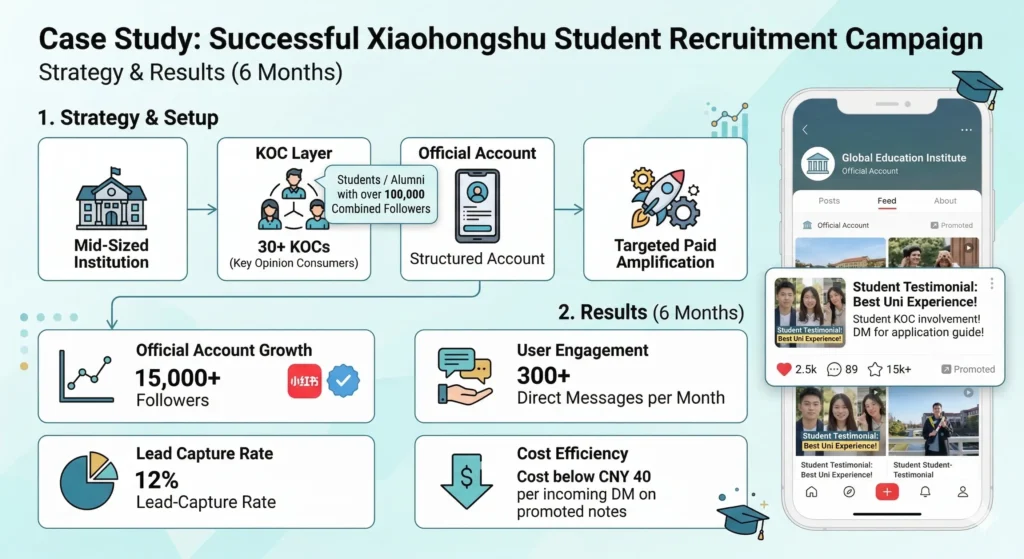
Here is a directional benchmark from an Australia-focused recruitment cycle running over six months, shared as industry context rather than a guaranteed outcome:
A mid-sized institution combined an official Xiaohongshu account with a structured KOC layer and targeted paid amplification. After six months, the official account reached 15,000+ followers, supported by 30+ KOCs with over 100,000 combined followers. The result: 300+ direct messages per month, a 12% lead-capture rate, and a cost below CNY 40 per incoming DM on promoted notes.
The metric that mattered most was not follower count. It was the combination of consistent proof-style content — real student experiences, transparent information, honest outcomes — paired with fast operational response at every enquiry touchpoint.
Common Pitfalls to Avoid
How universities attract Chinese students on Xiaohongshu usually fails when teams treat recruitment as content output only and ignore operations, compliance, and handoff quality.
| # | Mistake | Why it happens | How to avoid it |
|---|---|---|---|
| 1 | Treating China as a translation project | Teams localise language but not decision logic | Build separate value narratives for students and parents, each matching their actual priorities |
| 2 | Posting polished branding with no practical answers | Schools over-index on reputation marketing | Publish concrete guides, deadlines, and process clarity every week |
| 3 | Using unofficial conversion paths | Teams chase speed and move users to informal contact methods too early | Keep all handoffs through approved institutional channels with clear ownership |
| 4 | Running influencer activity without governance | Institutions copy consumer marketing playbooks | Use small, verifiable KOC programmes with explicit compliance rules |
| 5 | Measuring traffic instead of progression | Vanity metrics are easier to report | Track enquiry quality, response speed, and movement to application stages |
| 6 | Ignoring response operations | Content teams and recruitment teams work in silos | Define shared service standards and KPIs across marketing and admissions |
| 7 | Mixing official and creator roles | Teams expect KOC content to handle formal admissions communication | KOC handles trust signals only — official account owns policy, process, and approved conversion actions |
📈 Benchmark Data: What Does Success Look Like?
Based on industry averages for mid-tier to top-tier international institutions:
- Monthly DM Volume: 200 – 500+
- Qualified Lead Rate: 10% – 15%
- Cost per Incoming Lead: CNY 30 – 60 (via targeted ads)
❓ Frequently Asked Questions
Conclusion
Attracting Chinese students in 2026 requires moving away from “shouting” to “conversing.” By building an ecosystem that prioritizes transparency, student voices, and rapid response, your institution can transform from a distant name into a trusted future home.
Ready to localize your 2026 recruitment strategy? → Book your free China marketing consultation with Twish